
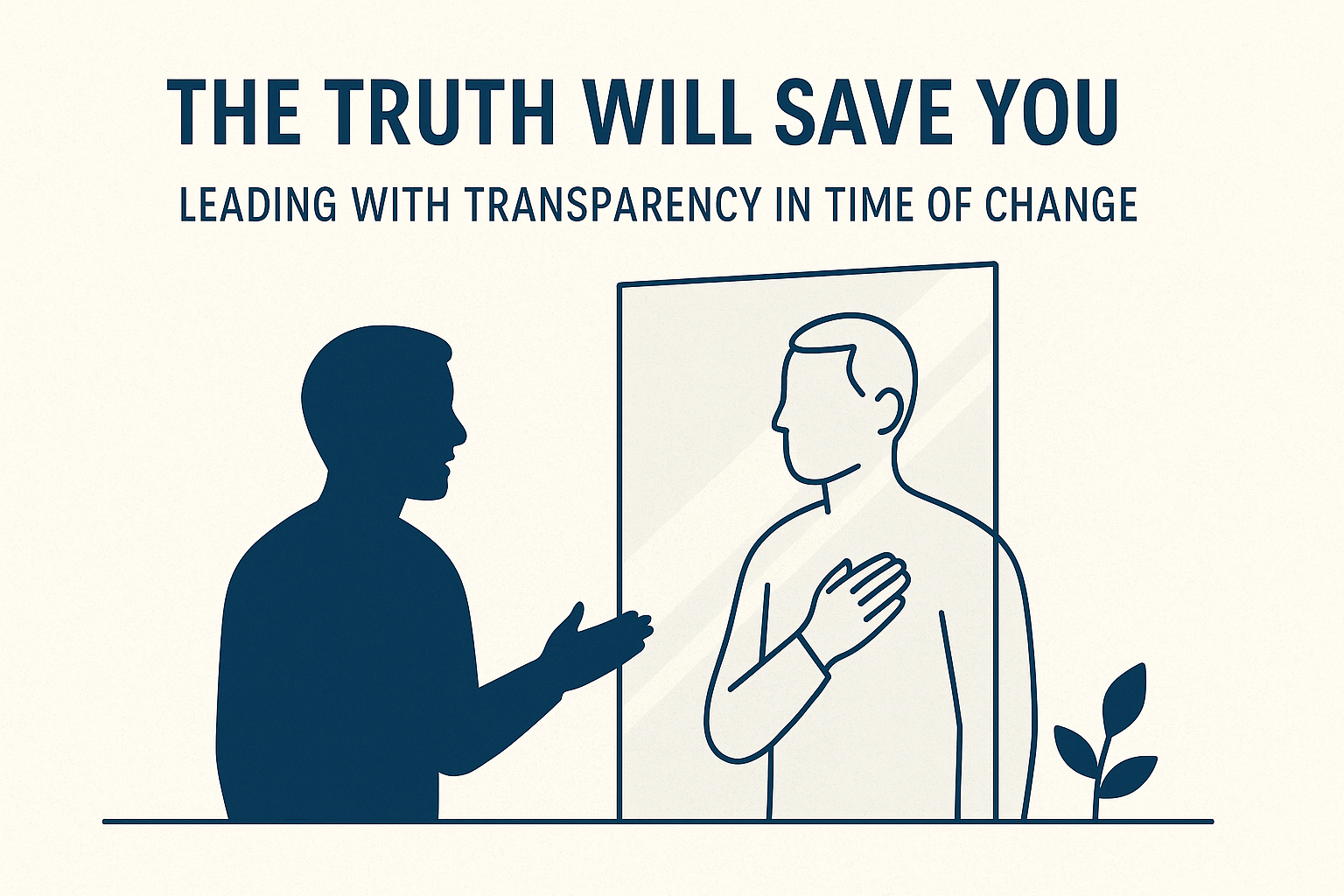
Introduction: The Illusion of Control
Leaders often think hiding problems buys them time. If staff don’t know about the funding cut, maybe morale won’t dip. If the board isn’t told about internal conflict, maybe they won’t lose confidence. If the community doesn’t hear about a failed pilot program, maybe reputation won’t take a hit.
But here’s the problem: what’s hidden doesn’t disappear. It festers.
When leaders hide, they may temporarily avoid discomfort, but they unintentionally invite larger crises. What’s left in the dark always comes to light — usually at the worst possible moment.
Transparency in leadership is not weakness. It’s not “airing dirty laundry.” It’s not handing your enemies ammunition. It’s the discipline of making the truth visible early enough that people can rally, adapt, and build solutions together.
The truth will save you more than it will ever harm you. In times of change, it may be the only thing that can.
What We Hide (and Why)
If you’ve ever led through change, you know the temptation:
- Budget realities: The money isn’t there to fund every initiative, but leaders hesitate to admit it.
- Missed deadlines: A rollout stalls, but nobody wants to acknowledge the slip.
- Staff morale: Teams are exhausted, but leaders pretend enthusiasm is enough to carry them.
- Failed pilots: A new tool, app, or program doesn’t deliver, but instead of course-correcting, leaders double down.
Why do we hide?
- Fear of losing credibility: We think if people see the cracks, they’ll see us as incompetent.
- Fear of panic: We assume honesty will overwhelm our teams.
- Fear of vulnerability: Leaders are taught to be strong, not transparent.
- Fear of conflict: Saying the truth out loud risks confrontation.
But here’s the paradox: hiding does the very thing leaders fear most. It erodes credibility. It creates panic. It exposes weakness. It multiplies conflict.
Transparency doesn’t create chaos. Lack of transparency does.
The Cost of Hiding
Hiding isn’t neutral. It has a cost — organizationally, personally, and ethically.
When there is no transparency in leadership, organizations pay the price. Money is wasted on ineffective processes. Staff feel disconnected. Communities lose faith.
Every hidden truth shows up somewhere else. And when it does, the cost is higher.
Transparency as Prevention
Think of it this way: transparency is fireproofing. Hiding is firefighting.
When transparency in leadership becomes the norm, problems turn into shared challenges, not secret burdens. It moves organizations from crisis management to solution orientation. Staff don’t expect perfection, but they do expect honesty.
Transparency turns suspicion into collaboration — and that shift saves leaders from burnout.
Common Fears Leaders Have About Transparency
Every leader wrestles with the same fears: panic, incompetence, complexity, authority.
The reality is, transparency in leadership doesn’t create panic, it prevents it. It doesn’t make you look weak, it builds credibility. It doesn’t strip authority, it deepens it.
The truth told with courage earns more respect than silence ever could.
What Transparency Is Not
Transparency gets misunderstood, so let’s clear this up.
Transparency is not:
- Oversharing every detail of every conversation.
- Dumping problems on staff without direction.
- Avoiding accountability by saying, “At least I was honest.”
Transparency is:
- Naming the real challenges early.
- Providing context and clarity.
- Consistently telling the truth, even when it’s uncomfortable.
- Modeling integrity, so staff and stakeholders can trust what you say.
Think of transparency as a practice of alignment: aligning what people feel with what leadership names. When reality and communication align, trust grows.
The Soul + Systems™ Connection
This is where the Soul + Systems™ Framework comes in.
Every system — SOPs, dashboards, policies, workflows — rests on culture. Without transparency in leadership, those systems become soulless. With it, they reflect reality and build trust.
Transparency isn’t optional. It’s the backbone of sustainable systems.
Reflection Prompts for Leaders
Here are three questions to ask yourself this week:
- Where am I hiding challenges from my team — and why?
- What’s one area where staff could help if they had the full picture?
- How does our culture treat mistakes: as failures to punish or as opportunities to learn?
Don’t just think about them. Write down your answers. Share them with a trusted colleague. Then ask yourself: what’s one step toward transparency I can take today?
Stories of Transformation
I’ve seen leaders transform organizations with one act of transparency.
One executive admitted to staff that their funding model was unsustainable. Instead of panicking, staff brainstormed cost-saving measures and identified new grant opportunities. The organization not only survived — it grew stronger.
Another leader revealed that a pilot program had failed. Instead of doubling down, they invited staff to share lessons learned. The next program was co-designed, and it succeeded because people trusted the process.
These aren’t exceptions. They’re examples of what happens when leaders stop hiding and start telling the truth.
The Ethical Responsibility of Transparency
Transparency isn’t just about performance. It’s about ethics.
Transparency in leadership demonstrates respect, honesty, and dignity. Without it, trust fractures both inside and outside the organization.
Why I Wrote This
As a Quality Strategist, consultant, and scholar, I’ve seen the damage secrecy does. I’ve watched organizations collapse under the weight of hidden dysfunction. I’ve watched leaders burn out because they carried burdens alone. I’ve watched communities lose faith in institutions that wouldn’t name the truth.
And I’ve seen the opposite. I’ve seen leaders tell the truth and invite solutions. I’ve seen staff rise when they felt trusted. I’ve seen organizations regain credibility by admitting mistakes and correcting course.
That’s why I keep saying: the truth will save you.
The Next Step: Moving from Truth to Transformation
Reading a blog is one thing. Living transparency as a leadership practice is another.
If you’re ready to go deeper, ask yourself:
- How can I build systems that actually reflect the truth of how we work?
- How do I align culture with operations so transparency becomes a norm?
- What tools exist to turn reflection into transformation?
That’s where my work with Soul + Systems™ comes in. It’s more than a framework — it’s a way of building organizations where transparency, trust, and transformation become inseparable.
👉 Download the Soul + Systems™ White Paper to see the five phases of application and real-world examples.
👉 Or connect with me to bring Pulse + Practice™ into your organization through consulting, training, or speaking.
Conclusion: The Truth Will Save You
Before you add another policy, system, or tool, ask yourself:
- Am I telling the truth about what’s really happening?
- Do my staff know what I know?
- Does my community trust that my words match our reality?
If the answer is no, start there.
Because transparency in leadership will save you. It will save your time, your credibility, your morale, your trust, and your organization’s future.
The truth will save you — but only if you lead with it.